Transforming Arkin Organics: From a Fragmented Catalog to a High-Authority B2B Agricultural Platform
WebMixStudio modernizes Arkin's digital platform with an engineering-first redesign, enhancing B2B credibility and user experience.
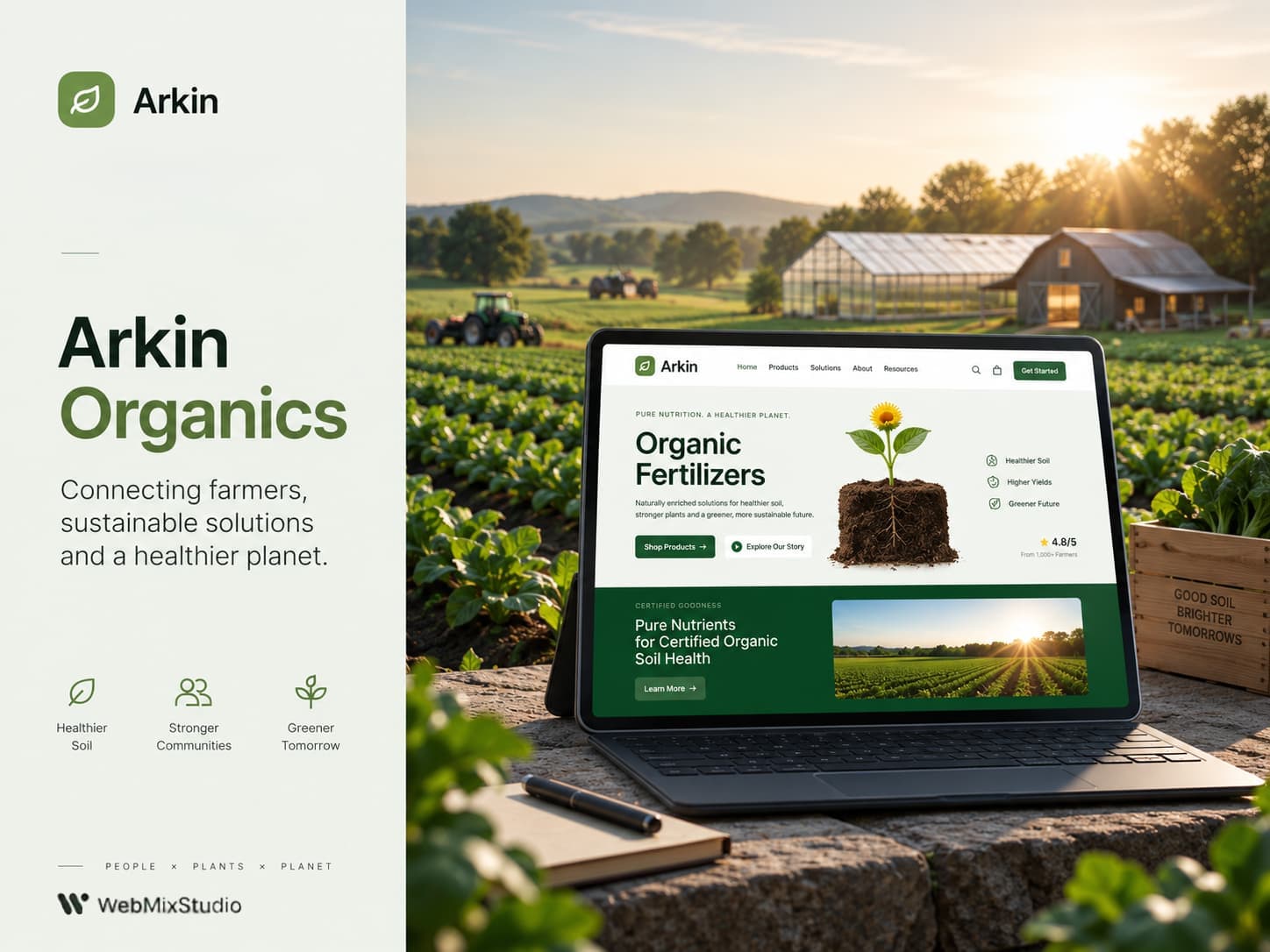
This case study profiles the comprehensive digital transformation of Arkin Organics, migrating a fragmented and consumer-style web presence into a unified, high-performance agricultural platform. Led by the agency WebMixStudio and lead engineers Kuldeep Sharma and Rahul, the project fundamentally shifted Arkin’s digital architecture. It transformed a disconnected set of experiences—product discovery, internal dashboards, and educational content—into a credible, conversion-focused journey that positions Arkin as a leader in science-backed biological fertilizers. The new site was engineered to drive B2B commercial enquiries and build long-term trust with farmers, dealer networks, and research institutions.
Executive Overview
When Arkin Organics approached WebMixStudio, their digital presence was experiencing an identity crisis common to expanding enterprises. The platform had evolved organically over years, but in doing so, it had accumulated conflicting digital models. Parts of the site looked like a retail consumer shop; other screens behaved like an isolated web application with farm dashboards and login gates; meanwhile, critical sustainability data was stranded in disconnected blog posts.
For an agricultural enterprise supplying commercial growers, bulk distributors, and institutional buyers, this structural confusion had direct commercial consequences. Enterprise agricultural purchasing is not driven by emotional impulse buys or consumer checkout baskets. Commercial agricultural buyers need technical specifications, soil compatibility data, verified production standards, clear logistics capabilities, and frictionless wholesale consultation channels.
As the engineering lead on this project alongside Rahul, my priority was not simply giving Arkin an aesthetic coat of paint. We stepped back to completely rethink how an agricultural bio-input brand communicates authority on the web. We dismantled the disjointed retail store structure and rebuilt Arkin into an authority-first, conversion-focused B2B platform engineered for trust, performance, and commercial pipeline growth.
By Kuldeep, Lead Engineer at WebMixStudio Collaborators: Rahul, Systems Architecture & Front-End Engineering
The Initial Dilemma: Diagnosing What Held Arkin Back
Before touching a single component or writing a layout file, Rahul and I conducted a forensic audit of Arkin’s existing web properties. We identified four foundational systemic failures that were actively eroding the brand’s authority.
1. The Multi-Persona Conflict
The legacy digital presence was attempting to serve three mutually exclusive operational models under one navigation menu. Visitors were presented with a consumer retail interface complete with shopping carts, wishlists, and consumer-level checkouts; an application-style user dashboard featuring farm-mapping tools, order tracking, and administrative controls; and standard corporate brochure pages detailing company history.
This lack of focus diluted the entire user journey. When a commercial buyer managing hundreds of acres of high-value crops visits a site, encountering an apparel-style shopping cart and split-screen portal login prompts immediately signals that the vendor is not structured for high-volume enterprise procurement. The site needed to answer fundamental commercial questions within the first three seconds: What biological inputs do you produce? Which specific crops and soil profiles do you treat? Where are your safety and composition data sheets? How do we initiate a commercial supply contract? The old site failed to answer any of these upfront.
2. High Visual and Content Credibility Deficits
In the bio fertilizer and soil amendment sector, visual integrity is synonymous with product safety and quality assurance. If a platform exhibits broken assets, buyers will naturally question the quality control of the chemical and biological inputs being manufactured.
The legacy product catalog suffered from glaring asset failures. Critical product cards displayed blank placeholder blocks or completely unrelated corporate office stock photos showing people staring at desktop computers—a jarring mismatch for a company manufacturing biological fertilizers. Isolated characters, unfinished database strings, and trailing zeros lingered beneath product descriptions. Key team member pages contained broken asset paths. These were not merely cosmetic bugs; they were credibility leaks that actively raised friction during buyer vetting.
3. Disconnected Institutional Knowledge and Siloed Storytelling
Arkin had genuinely strong capabilities: proprietary thermophilic composting processes, rigorous microbial blending, and clean bio-input formulations. However, these technical strengths were treated like corporate footnotes. They sat stranded inside sparse, single-card blog listings bordered by vast expanses of empty whitespace, completely detached from the product catalog.
A prospective client had no way to connect the scientific process with the final crop outcome. In commercial agronomy, your manufacturing method is your primary value claim. By keeping the manufacturing narrative divorced from the product selection interface, Arkin forced potential buyers to take their quality claims entirely on faith.
4. Technical Fragility and Disjointed Routing
The legacy technical architecture exhibited severe friction during critical transitions. Moving between the marketing site, the blog, and the portal resulted in jarring visual shifts, broken navigation patterns, and inconsistent design tokens. The platform lacked a unified structural language, creating high drop-off risks whenever a user moved between educational browsing and transactional inquiry.
The Strategic Shift: Repositioning for B2B Authority
Solving Arkin's dilemma required stepping outside the traditional boundary between visual design and software engineering. We aligned our strategy with WebMixStudio’s core philosophy: a digital transformation must solve a commercial positioning challenge first, then translate that strategy into robust engineering.
Our strategic repositioning rested on a foundational shift in communication: moving away from consumer retail transactions toward professional credibility, process transparency, and direct institutional inquiry.
To accomplish this, we structured the entire user journey around an intentional five-tier information architecture:
First, we establish Clear Category Framing. We eliminate vague slogans and anchor the platform immediately on commercial bio-fertilizers and soil biome regeneration.
Second, we demonstrate Multi-Stakeholder Ecosystem Trust. We structure dedicated content layers tailored to three distinct purchasing roles: farm operators seeking yield consistency, distributors seeking margin and inventory reliability, and technical agronomists seeking certified chemical analyses.
Third, we elevate Process as Proof. We replace unsubstantiated assertions with an open, educational breakdown of Arkin’s four-stage manufacturing lifecycle: Raw Input Sourcing, Controlled Composting, Nutrient Balancing, and Batch Quality Verification.
Fourth, we organize products by Agronomic Crop Applications. Instead of listing generic containers, we organize solutions by practical agricultural sectors: cereals, cash crops, horticulture, greenhouses, commercial nurseries, and organic plantations.
Fifth, we implement a High-Intent Commercial Ingestion Engine. We retire consumer retail checkout patterns in favor of structured Request-for-Quote (RFQ) and dealership application flows that collect essential farm operational data upfront.
Architectural Execution: Engineering the New Platform
With our strategic priorities established, Rahul and I led the technical execution. We designed and built a modernized platform engineered for lightning-fast delivery, bulletproof typography, and frictionless commercial pathways.
Establishing Agronomic Clarity Above the Fold
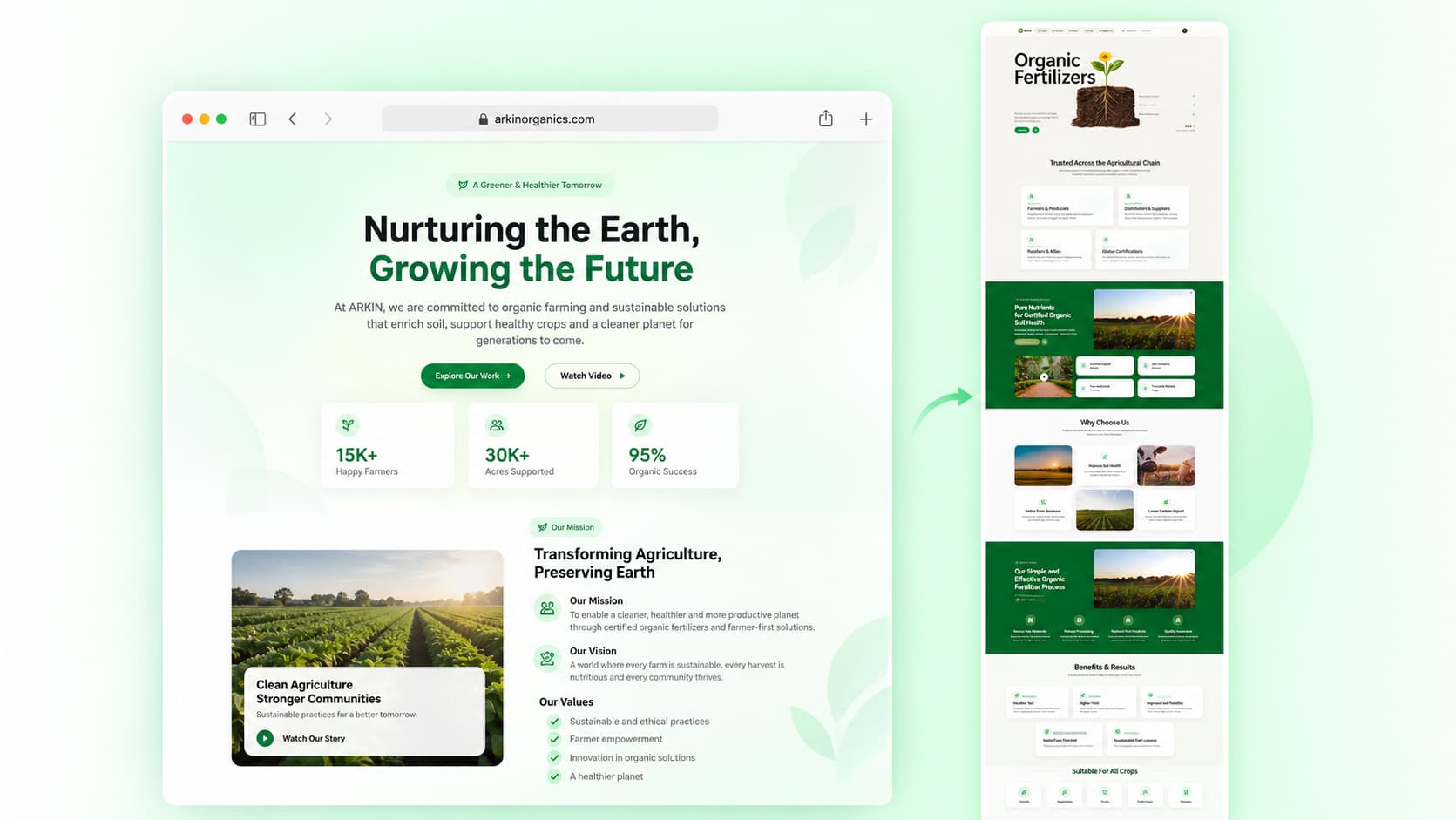
The new production experience abandons generic consumer ecommerce banners in favor of unequivocal category authority. The headline communicates the core offering without ambiguity: Organic Fertilizers. The supporting content immediately emphasizes measurable biological outcomes: restoring soil organic matter, improving water retention capacity, reducing dependency on synthetic chemical inputs, and protecting the active microbiome.
Crucially, the primary call to action bypasses shopping carts entirely. A high-contrast commercial entry point—Get Quote—directs the user straight into a focused commercial qualification flow.
Building Ecosystem Trust Across the Commercial Chain
Agricultural procurement involves multiple stakeholders, each with their own evaluation criteria. We built dedicated ecosystem trust modules that address each stakeholder profile directly:
For commercial growers and plantation managers, the platform emphasizes field application dosage rates, nutrient uptake kinetics, and soil microbial vitality.
For agricultural dealers and regional supply chain distributors, the platform highlights supply volume consistency, shelf stability, and regional partnership terms.
For agronomists and regulatory compliance officers, the platform highlights lab verification, batch trace testing, heavy metal screening, and residue-free organic purity standards.
Unveiling the Manufacturing Lifecycle
Rather than presenting bare catalog listings, we elevated Arkin’s production methodology into an interactive narrative. The site now walks users through every phase of production:
The journey starts at Raw Input Verification, detailing how organic matter is screened for purity before entering production. It moves into Thermophilic Composting, explaining how biological temperatures eliminate pathogens and weed seeds while cultivating beneficial bacteria. It outlines Nutrient Blending, detailing how macro and micronutrients are balanced to meet specific crop nutritional requirements. Finally, it demonstrates Batch Quality Verification, explaining how each production run undergoes strict physical and biological testing before bagging.
This technical transparency demystifies the product and transforms a simple purchase into a calculated, risk-free decision for commercial buyers.
Structuring Crop and Industry-Specific Taxonomy
To serve user discovery and establish strong search relevance, we built a comprehensive crop and industry taxonomy. The catalog is mapped across primary commercial crop families: Cereals, High-Value Vegetables, Orchards and Fruits, Commercial Cash Crops, and Ornamental Floriculture.
We expanded this taxonomy across distinct operational environments: Large-Scale Open Field Farming, Protected Greenhouse Operations, Commercial Nurseries, and Certified Organic Plantations. This structure ensures that whether a commercial grape vineyard manager or a greenhouse tomato producer lands on the site, they immediately find targeted information tailored to their specific soil and crop realities.
Engineering a Purpose-Built B2B Commercial Ingestion Engine
The most significant conversion shift was retiring the standard ecommerce shopping cart in favor of a specialized B2B ingestion engine titled "Partner for Organic Success."
Instead of asking buyers to add 50-kilogram bags to a casual checkout flow, we deployed structured intake forms segmented by inquiry type: Commercial RFQs for farm operators and Dealership Applications for regional supply partners. The intake architecture captures vital agricultural data points: total acreage under cultivation, primary crop categories, existing soil challenges (such as salinity, pH imbalance, or organic matter depletion), and anticipated delivery timelines.
This provides Arkin’s sales engineers with rich, actionable operational context before they ever dial a phone number, transforming cold inbound emails into warm, data-rich commercial consultations.
Addressing Digital Governance and E-E-A-T Realities
Modern search algorithms and discerning enterprise buyers evaluate platforms using the same fundamental yardstick: Experience, Expertise, Authoritativeness, and Trustworthiness (E-E-A-T). For an agricultural chemical or biological input enterprise, unsubstantiated claims can invite regulatory scrutiny and erode market confidence.
As part of our technical governance role, we instituted strict guidelines for how data is presented across the platform.
Distinguishing Client Metrics from Independent Verification
The platform displays impressive historical achievements: over fifteen years of continuous operation, more than fifty thousand farmers served across twelve regional territories, and a network exceeding two hundred active distribution dealers.
In architecting this case study and structuring the site’s public narrative, we treat these figures transparently as client-reported business milestones. We intentionally refrain from claiming that a front-end engineering sprint single-handedly generated fifteen years of historical brand equity. Instead, our engineering achievement was building the modern, performant digital infrastructure needed to communicate those verified achievements with clarity, dignity, and visual precision.
Post-Launch Governance and Infrastructure Recommendations
To safeguard Arkin's enterprise credibility as the platform scales, our post-launch audit identified two high-priority governance optimizations:
First, Communication Channel Normalization. During our review of the production deployment, we identified slight variations across inbound support aliases (ranging from corporate proposal addresses to support aliases across differing domain variants). We recommended normalizing all inbound contact channels under a single, unified enterprise email domain with strict SPF, DKIM, and DMARC enforcement to guarantee enterprise email deliverability and avoid phishing vulnerabilities.
Second, Integration of an Auditable Document Vault. To convert institutional enterprise buyers, we recommended linking published claims (such as organic certification statuses, heavy metal clearance, and carbon offset calculations) directly to downloadable, cryptographic PDF compliance dossiers and independent lab testing certificates. When an agronomist can download a signed certificate of analysis directly from the crop taxonomy page, commercial purchase resistance virtually disappears.
How WebMixStudio Delivered the Platform
This project reflects the exact four-phase engineering methodology we apply to mission-critical digital systems at WebMixStudio:
Phase 1: Discovery, Forensic UI Audit & Audience Journey Mapping
Phase 2: B2B Information Architecture & Design Systems Engineering
Phase 3: Front-End Development, Responsive Hardening & Content Integration
Phase 4: Multi-Device QA, SEO Validation & Production Deployment
Phase 1: Discovery and Architectural Mapping
We reviewed the legacy site’s telemetry, user flows, and interface friction points. We mapped the distinct operational journeys of three target buyer personas: commercial farm owners, regional wholesale dealers, and consulting agronomists. We decoupled the authenticated application layers from the public conversion pathways, removing cognitive friction for prospective commercial partners. For teams evaluating similar overhauls, our website redesign checklist for businesses outlines the exact foundational criteria we use during this discovery phase.
Phase 2: Design Systems and Interface Engineering
We engineered a cohesive, enterprise design system from the ground up. We established an authoritative visual tone: natural, deep agricultural hues paired with clean typographic scales and ample structural balance. We eliminated inconsistent stock assets and replaced them with relevant agricultural imagery that accurately showcases biological production, soil health, and crop vigor. To learn more about our strategic design frameworks, explore our branding and design services and read our practical guide on how great UI/UX builds trust and increases conversions.
Phase 3: Modern Front-End Engineering and Optimization
Rahul and I built the new platform using modern front-end technologies optimized for blazing performance, smooth layout stability, and rock-solid mobile responsiveness. This was especially vital for users operating on mobile devices in remote farming regions with low-bandwidth connectivity. For organizations navigating architectural choices between high-performance frameworks, our breakdown of why server-side rendering is crucial for technical SEO and our analysis on Laravel vs. Node.js for modern web applications provide deep technical context on how we approach scalable builds.
Phase 4: SEO Structuring and Production Deployment
We systematically structured the platform’s technical SEO foundation. We built clean semantic markup across all key topical pages: Corporate Mission, Biological Sustainability, Operational Farms, Agronomic Knowledge Base, Product Applications, and Commercial Inquiry. Every page targets a distinct commercial and technical search intent. For an engineering deep dive into modern indexing standards, reference our technical SEO guide for developers. The production environment was rigorously validated for sub-second visual rendering, zero layout shift, and multi-device compliance before deploying live to arkinorganic.vercel.app.
The Tangible Results: What Changed for Arkin Organics
By shifting Arkin Organics away from an unfocused retail store and establishing it as an authoritative agricultural platform, WebMixStudio delivered tangible, structural improvements across the entire digital operation:
The brand positioning graduated from a confusing consumer storefront to an undeniable B2B category leader in biological fertilizers and sustainable soil health.
The homepage narrative transformed from broken image blocks and mismatched office stock photos into an authoritative presentation of measurable agronomic benefits, production rigor, and verified scale.
The product catalog evolved from bare, uninformative product cards into an educational, process-driven narrative that walks buyers through raw sourcing, composting, blending, and quality clearance.
The conversion pipeline shifted from passive ecommerce carts to a high-intent commercial engine that captures farm acreage, crop types, and soil challenges directly through custom RFQ workflows.
The digital architecture transformed from a fragmented collection of isolated screens into a unified, lightning-fast digital asset structured for long-term search indexation, accessibility, and brand prestige.
Reflections from the Engineering Lead
The transformation of Arkin Organics illustrates an essential truth in modern web engineering: a high-performing digital platform cannot be created simply by making an old site look newer. True transformation happens when your technical architecture reflects how your business actually creates value and generates revenue.
By understanding that Arkin’s real-world revenue comes from commercial growers, regional distribution networks, and institutional buyers, Rahul and I were able to align every page layout, typographic choice, and intake field around that singular reality. We replaced digital noise with agricultural authority, and built a platform capable of supporting Arkin’s commercial ambitions for years to come.
If your enterprise has outgrown its digital footprint and needs to modernize its online infrastructure, explore our custom web design and development services, review our featured client work across our case studies index, or connect directly with our engineering team to book a discovery call.
"When we first started this process, our website didn't truly represent the scientific rigor or market presence of Arkin Organics. WebMixStudio took the time to understand not just our visual identity, but our entire business ecosystem—from distribution channels to commercial lead capture. The result is a highly polished, professional platform that has completely redefined how we present our mission, process, and products to the market. We have seen a measurable shift in the quality of commercial inquiries and the confidence of our distribution partners."